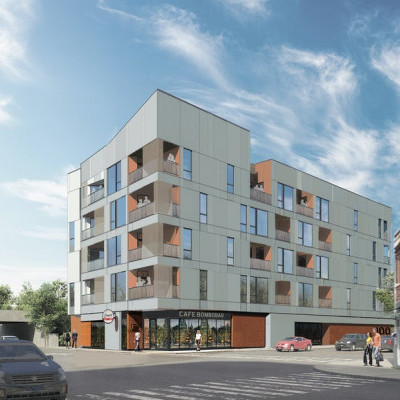
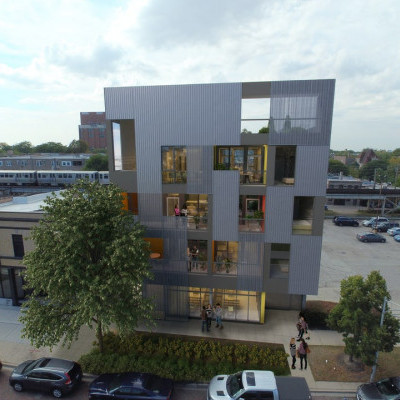
Bridgeview Bank, an important architectural and cultural icon located in Chicago’s Uptown neighborhood, was designed by Marshall & Fox and constructed in 1924 for the Sheridan Trust and Savings Bank. Its ownership has changed several times throughout its history, from New York Life in 1931, to Bridgeview Bank in 2003, and finally to Cedar Street Properties in 2019. The building is a contributing structure to the Uptown Historic District and was declared a Chicago Landmark in 2008.
The Cedar Street and Level teams are in the process of revitalizing this important neighborhood and regional landmark into a vibrant live/work community by repositioning the ground floor retail and commercial office spaces, converting the banking hall to a co-working space, and building out the upper floors with 176 apartments consisting of studio and one-bedroom units.
The Level team went to great lengths to preserve the integrity of this historic landmark. Of course, architects working on adaptive reuse projects always need a reliable set of drawings of the existing building to begin work, but documenting a large property in a way that is both accurate and time-sensitive can prove challenging. The process of meticulously measuring the many elements of the building and then returning to our desks to draw our findings can be tedious. Luckily, there is technology that can help.
Level worked with PMC, a company that produces 3D scans of existing structures, to tackle the large task of documenting Bridgeview Bank. PMC uses 3D laser scanning to gather site coordinates. This amazing technology involves projecting millions of laser beams onto points throughout the interior and exterior of the building. This establishes an equal number of data points in space, which can then be used to digitally render the site with great accuracy in our BIM/Revit software. PMC was able to scan all of the historic aspects of Bridgeview Bank, including its exterior. With that scan, they produced the 3D model that Level used in our design process.
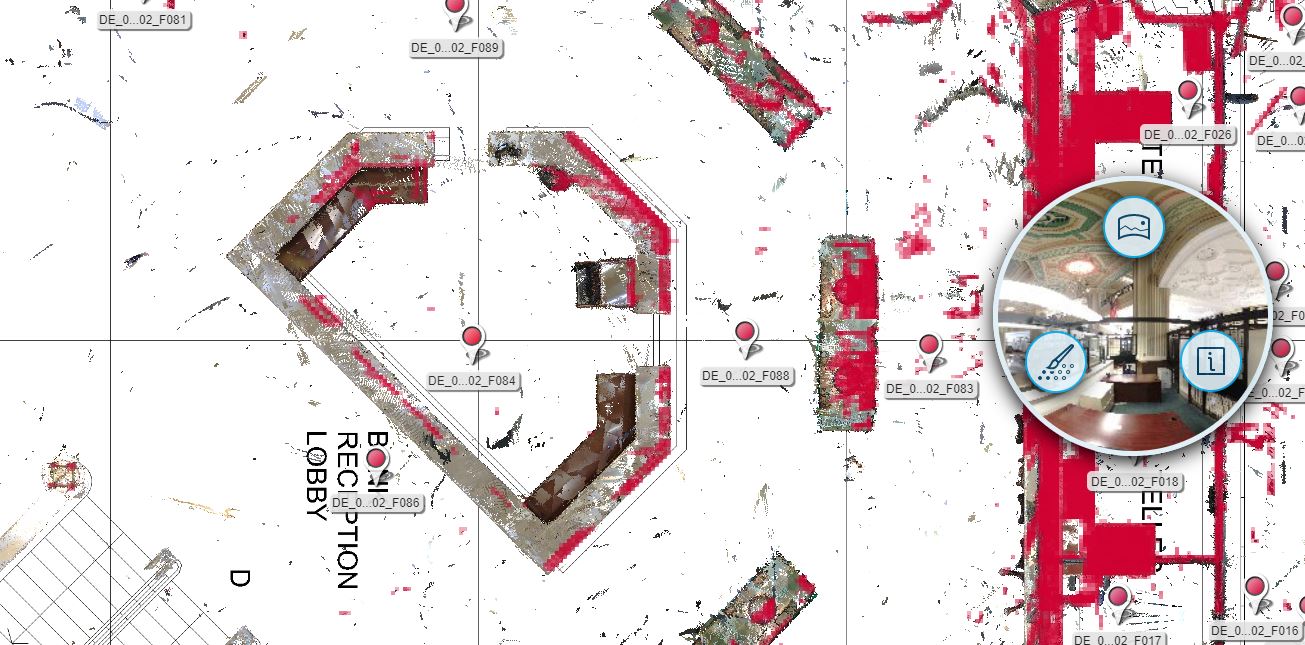
Some of the scans look quite abstract at first glance.
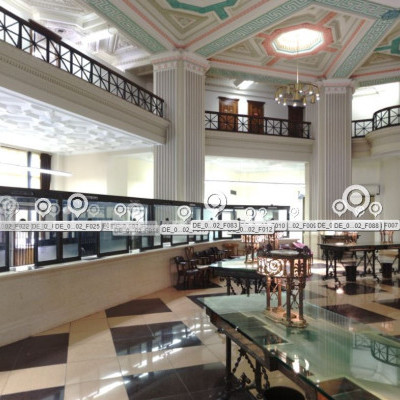
The plot thickened: we were beginning this project during the start of the pandemic, when it was not safe to visit the site in person. In answer to this issue, the team at PMC created a Webshare — an online space which contains all the images that were taken while they scanned the building. The images were then stitched together in a way that allows the user of the Webshare to walk through the building virtually and look around.
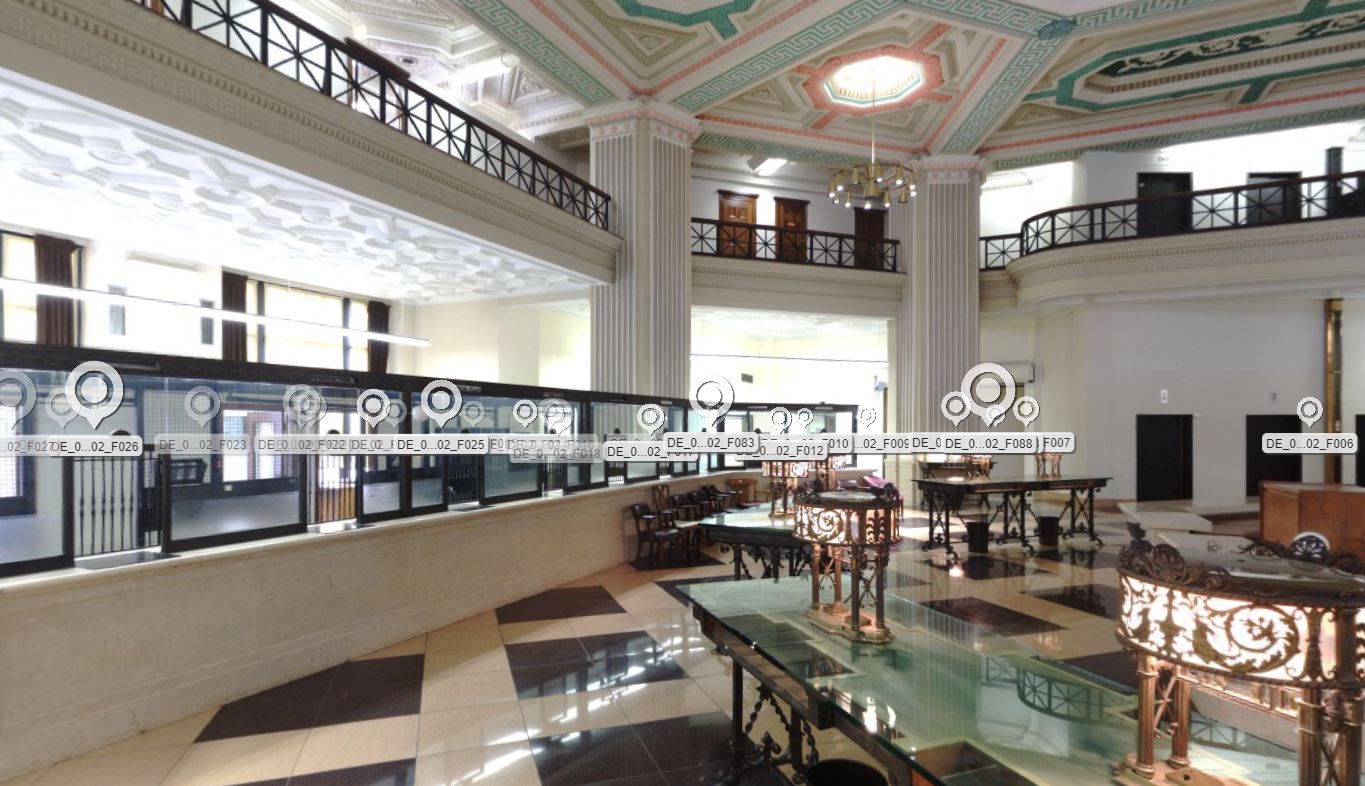
Webshare photo with points: Each bubble in this photo takes the viewer to a point in which the scanner was set up. The viewer can pan around 360 degrees to see the space.
The Webshare was extremely helpful, as it allowed us to reference accurate images when we had questions about existing site conditions. Another feature of the Webshare was a measuring tool, which let our team acquire a close estimate of dimensions. All stakeholders and members of the design team had access to this website. Our BIM360-hosted Revit models allow us to work completely on the cloud, meaning that in combination with the Webshare, Level was able to design for the Bridgeview renovations without visiting the site until it was safe to do so.
Our team also encountered many situations in which the City of Chicago Landmarks or The National Park Service needed to understand how the bank was originally built versus how it looks now. For example, The National Park Service was concerned with preserving the look and feel of the historic corridors — primarily, they were looking for the spaces to maintain the rhythm of door locations from floor to floor. Bridgeview Bank contains eight historic corridors, and over the history of the building, many changes have occurred to door locations, transoms, ceilings, and more. By cutting a section through the residential corridor on the point cloud, we were able to see how different each corridor actually was from its fellows, and adjust them to become more regular.
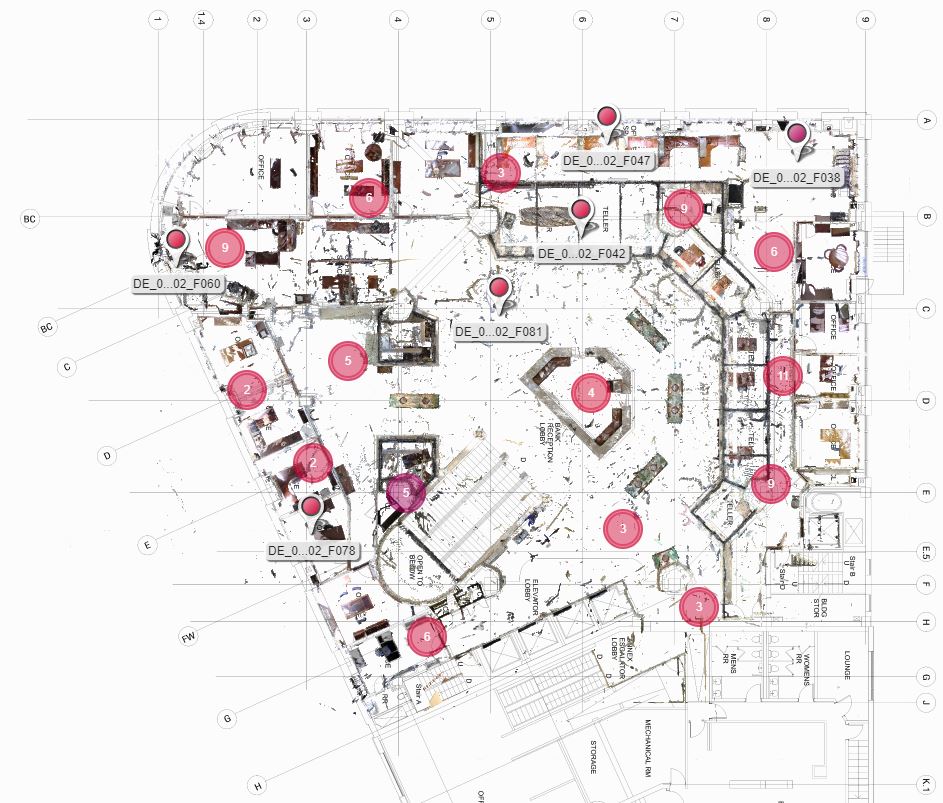
Webshare interface of the banking hall
Level has always embraced industry-leading technology, but never have the stakes been this high. Even through the pandemic, laser scanning allowed us to continue our adaptive reuse of Bridgeview Bank, which will revitalize this neighborhood landmark and bring new living and working space to the historic Uptown area.